
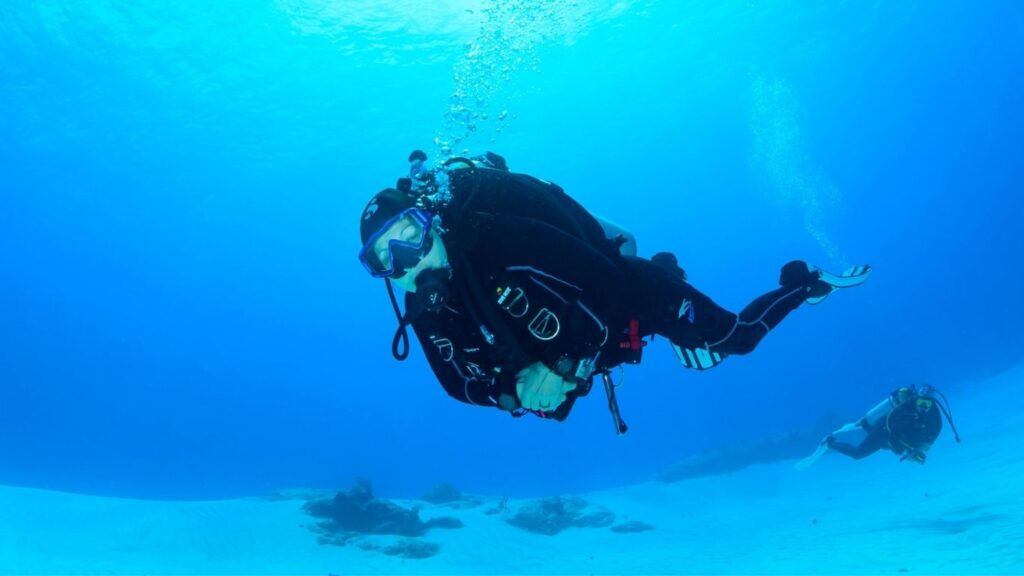
As scuba divers, we know that the water does something transformative to you that nothing else quite replicates. You surface from a dive feeling calmer, clearer, and more like yourself than when you went in. And then real life starts up again, and the feeling fades.
Most divers accept that the calm does not last and do not think to question it. Nobody told them that the calm they found at depth was something they could learn to hold on to, or that who they become underwater could carry into how they handle a hard conversation, how they trust themselves in an uncertain moment, how they show up in their own life. That’s where somatic practice comes in.
I developed Dive Somatics℠ because that gap between the you underwater and the you on shore can feel very real, and it does not have to be. Dive Somatics℠ is body-based awareness work that teaches you to notice what is happening in your body before, during, and after a dive, and to use what diving gives you rather than lose it. Your dives get better. And diving itself becomes more than a sport you love. It becomes a practice that makes the rest of your life feel more like you.
What Somatic Practice Actually Is
Somatic comes from the Greek word soma, meaning “body”. Somatic practice is body-based work that starts from a simple premise: your body is not just carrying out orders. It is an intelligent system, and the thinking mind is usually the last to know what it is doing.
Somatic practice is the intentional development of awareness of what is happening in the body, in real time, and the cultivation of a conscious relationship with those signals rather than an automatic one.
In plain terms, you stop reacting automatically to what your body is doing and start actually working with it.
People often ask if it is the same as mindfulness. It shares some ground. Mindfulness asks you to watch what is happening. Somatic practice asks you to get closer. To notice what your body is already doing, stay with it, and learn to work with it rather than override it. That is the whole practice. Your body has been tracking it all. You are just learning to read it.
What Your Body Is Already Doing Underwater
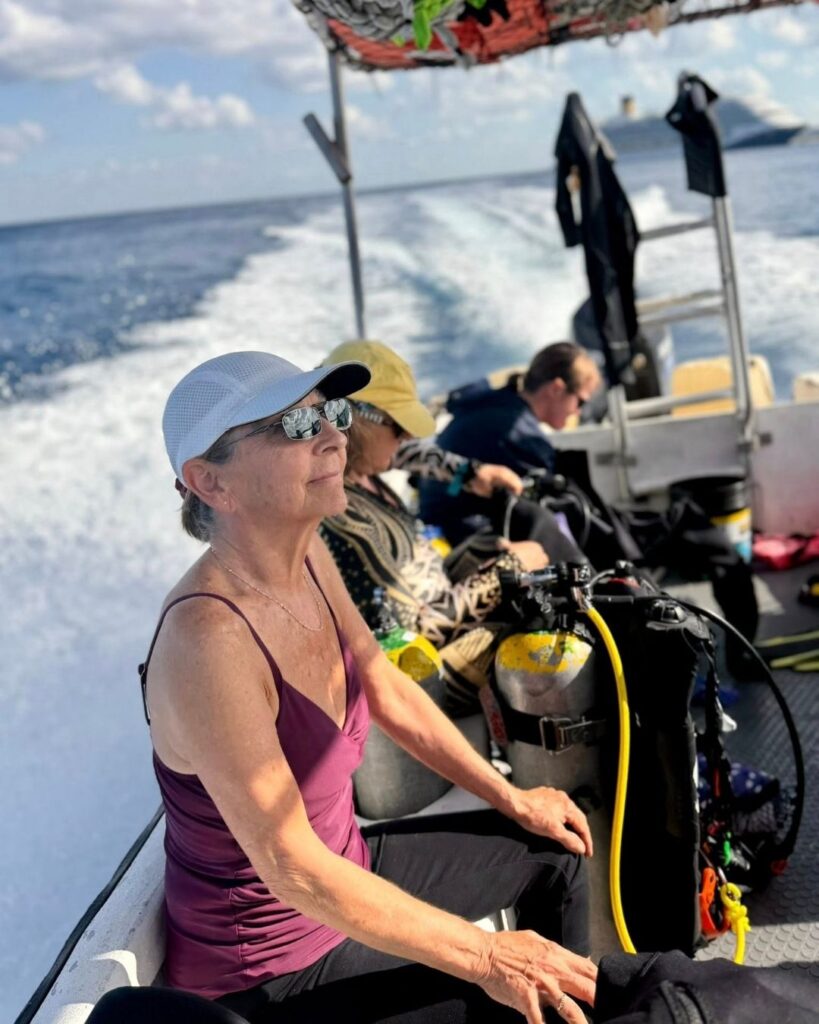
Before a dive, your nervous system is already sorting through what you brought with you from the day, the nerves you did not quite shake, the conversation you had on the boat, and the current running across the site. None of this is conscious. It is happening in the body, without you deciding any of it, and it shapes how you move throughout the dive.
For many women, this is where it gets complicated. The body walking down that dock is not just a body going for a dive. It is carrying interrupted sleep, the hormonal shift nobody mentioned in the open-water manual, a body that has not had a quiet moment since she woke up, understanding what that actually does to you before a descent matters more than anyone told you when you got certified.
Once you are in the water, your body continues to manage the pressure change, the temperature, and the complete rethinking of how you breathe. It’s tracking your buoyancy, your position, and the diver next to you, all of it at once.
Most divers just get on with it. They talk themselves down at the surface, find a rhythm somewhere deeper, then surface feeling better than they went in. Nobody taught them anything different.
I have watched the whole sequence play out more times than I can count. The slow release is somewhere around fifteen feet. Nothing decided it. The body simply figured it out.
Somatic practice is interested in what’s happening in your body at that particular moment. Not with the intention of explaining it away, but to work with it.
Why the Underwater Environment Is Uniquely Suited for Somatic Work
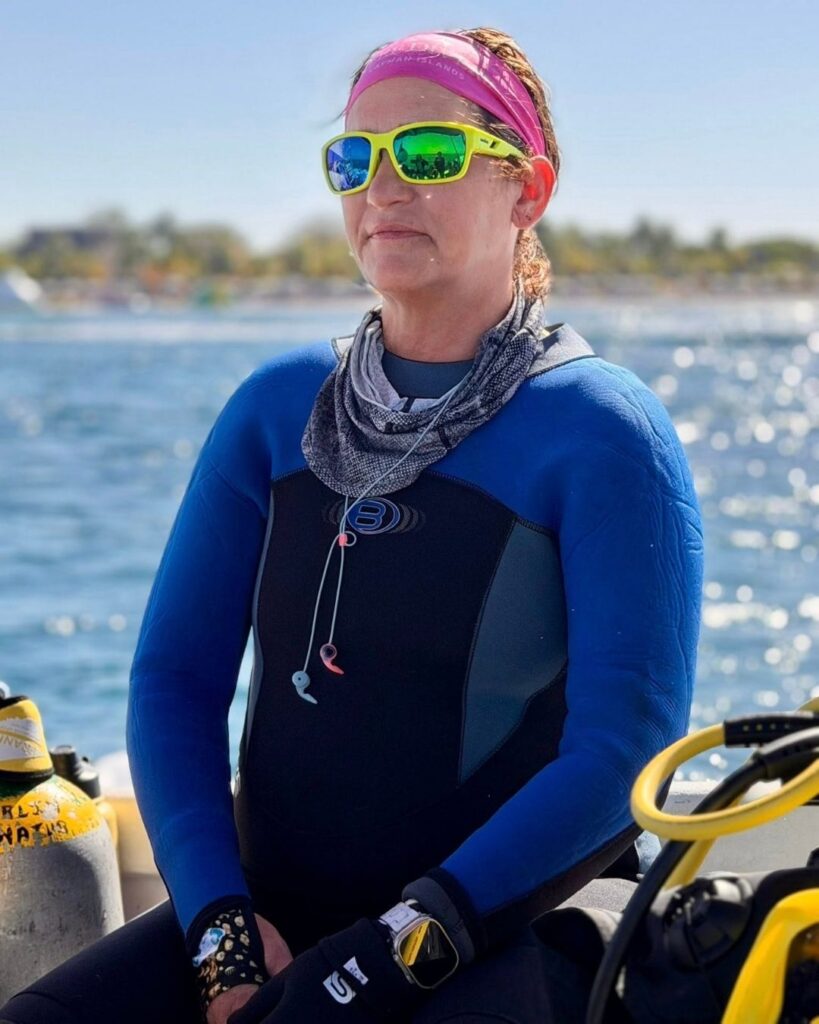
On land, somatic practice asks something of you before you even begin a dive. Find the quiet, clear the distraction, protect the few minutes you carved out before something else takes over. Most people manage a few minutes at a time on a good day.
Underwater, the conditions are already there and working in your favor. The environment helps cut out interruptions, and nobody can reach you. The only thing asking anything of you is the water, and it asks with complete clarity.
What the water does to the nervous system is not incidental. The physiological shift is real, and it goes deeper than most divers realize.
Every diver who has ever felt that quiet, peaceful shift underwater is already doing this work, whether she knows it or not. What she may not have is the language for it. Or a way to use it on purpose. Combining diving with Somatic practice gives her both.
Three Divers. The Same Practice.
Somatic practice in scuba diving is not just for anxious divers. It is for any diver who has ever felt something shift underwater and wanted more of it, to understand it, or just to stop losing it the moment she surfaced.
The first diver feels the edge before every descent and knows something is moving in her body. She has probably learned to push through it. But somatic practice gives her a different option: to meet it, understand it, and decide whether she wants to work with it rather than push past it. That usually starts with understanding the difference between what fear feels like and what danger actually is.
The second diver is confident in the water but notices her air consumption spikes when conditions shift. She feels the excitement of a big dive translate into a kind of physical acceleration she cannot always manage. Knowing what is actually happening changes how she moves through it. The edges do not disappear. They become information.
The third type of diver comes to this work not because something is wrong but because something is right. She already knows the feeling. The deep calm of a good dive. The way time moves differently at sixty feet. She comes back to the water partly because of what it gives her. Somatic practice teaches her to access it more often and carry it with her when she surfaces.
Three entry points. You may have experienced one or all of them. I built Dive Somatics℠ for every kind of diver.
What This Looks Like in the Water
In a dive context, somatic practice does not look like a set of steps to follow. Instead, it is a quality of attention. It develops over time, but I tend to see it develop the fastest in the water.
It looks like arriving at the water and noticing what you actually brought with you, not assessing it or trying to change it, but simply noticing it. It could be noticing the quality of your breath before you enter, the degree of presence or distraction in your body, or recognizing the first five feet or a dive for what they often are: the moment of highest nervous system demand in the entire dive. Not a problem to eliminate, but a signal worth understanding.
It looks like what happens to your body when the breathing settles, and knowing it is not just relief. Your body moved from one state to another. A breathwork practice built before you are ever in the water makes that shift easier to find.
And it looks like ascending with that calm and choosing to carry it into the rest of the day instead of leaving it at the dock.
Dive Somatics℠ and What It Is Built On
I developed Dive Somatics℠ at the intersection of somatic practice, trauma-informed coaching, and the underwater dive environment. I did not build this from theory. I built it from what I kept watching happen in the water, and from what I knew about the body from the work I had done on land.
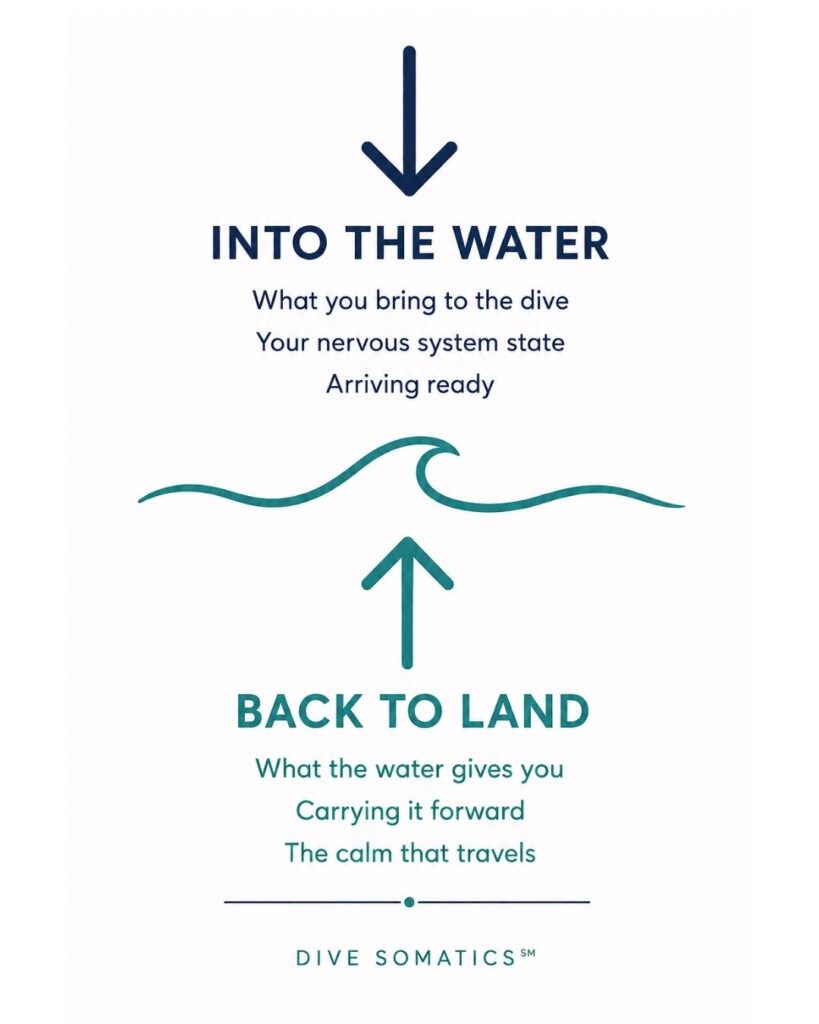
It works in two directions. The first is to be in the water, where you notice what you bring to the dive and learn how to work with your nervous system so you arrive at the water ready. The second is back to land, where you absorb what the water gives you and learn to carry it forward rather than leave it behind when you surface.
Dive Somatics℠ is not a therapy program or an anxiety fix. It is for any diver who knows the water gives her something and wants to carry it forward into other areas of life. The nervous system is the mechanism, presence is the goal, and better diving is what most people notice first.
What the Water Has Always Been Doing
You know that feeling at sixty feet when the breathing settles, and something in the body that was held tight releases. It is not a mystery. It is physiology. It is your nervous system responding to an environment that meets you where you are.
Somatic practice is what happens when you stop letting that process run on autopilot and start paying attention to it. What the water gives you does not have to stay in the water. Dive Somatics℠ is how you learn to make that happen.
There is a free guide that goes further. Dive Somatics℠: A Guide For Divers is where the practice starts to become something you can actually use.
To calm and confidence,

Frequently Asked Questions
What is somatic practice in scuba diving?
Somatic practice in scuba diving is body-based awareness work applied to the underwater environment. It trains attention on what is happening in the body in real time, developing a conscious relationship with physical signals rather than an automatic one, meaning you notice and work with what your nervous system is doing before, during, and after a dive.
Do I need to have dive anxiety for somatic practice to be relevant to me?
No. Somatic practice in scuba diving is not an anxiety program. It is a methodology for any diver who wants to actually know what her body is doing underwater. Confident divers use it to understand why their air consumption changes in certain conditions, to access the calm of a good dive more deliberately, or to carry that feeling into the rest of their day. Anxiety is one entry point. It is not the only one. If you are curious about what panic actually is and how the body gets there, that is a different and useful place to start.
Who created Dive Somatics℠?
Dive Somatics℠ was developed by Nicole Harrison, PADI Instructor and certified somatic practitioner, at the intersection of trauma-informed somatic practice and the specific demands of the underwater environment. Nicole is a certified somatic practitioner and trauma resiliency coach.
What is Dive Somatics℠?
Dive Somatics℠ is a proprietary methodology developed by Nicole Harrison at the intersection of somatic practice and the scuba diving environment. It is not a certification pathway or an add-on to dive training. The Dive Somatics℠ Foundation Program is a guided audio series of six sessions designed to develop the skill of intentional presence in both directions: into the water and back to land. It is a practice, not a course you complete and set aside.
How does somatic practice connect specifically to scuba diving?
Scuba diving affects the conditions for this work in ways that land cannot replicate. The distractions are gone. The physical demands are immediate. The calm the water produces is not a side effect. These things are not the backdrop to somatic practice in diving. They are where the practice lives.
