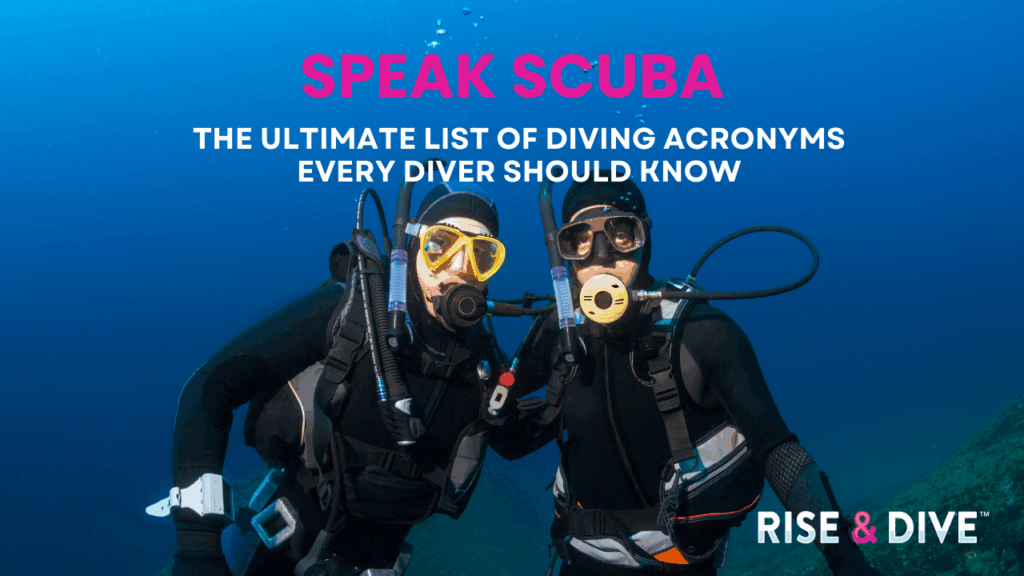
When I first started scuba diving, it felt like learning a new language held by a secret society. Between the gear setup, training levels, and safety briefings, people were tossing around dozens of scuba diving acronyms like they were part of normal conversation—and I was just nodding along, hoping I wouldn’t get quizzed later.
You’re not alone if you’ve ever felt this way. Whether you’re new to diving, coming back after a break, or just trying to keep up with the dive boat chatter, this list will help you feel more confident and informed.
This cheat sheet of scuba acronyms covers the ones you’ll actually hear on dive boats, in training, and in everyday dive life—plus a few lesser-known terms that are good to know. From safety lingo to gear talk to certification shorthand, these abbreviations help decode the language of diving and keep you in the know underwater and topside.
Dive Planning & Safety Acronyms
BWRAF – Begin With Review And Friend or Big Whales Really Are Fat – A buddy check acronym to review: BCD, Weights, Releases, Air, Final check.
DC – Dive Computer – A wearable device that tracks depth, time, NDLs, ascent rate, etc.
EANx – Enriched Air Nitrox – A breathing gas blend with 22–40% oxygen (most commonly 32% or 36%), used to reduce nitrogen absorption and extend no-decompression limits compared to regular air.
MOD – Maximum Operating Depth – The maximum depth at which a specific gas mix can be safely used.
NDL – No Decompression Limit – Time at depth without requiring decompression stops.
OTU – Oxygen Tolerance Units – Tracks cumulative oxygen exposure (tech diving).
PO2 – Partial Pressure of Oxygen – Used in gas planning.
RNT – Residual Nitrogen Time – Nitrogen leftover in your body from previous dives.
SI – Surface Interval – Time on surface between dives for off-gassing.
TBT – Total Bottom Time – Sum of actual dive time plus residual nitrogen time.
VPM – Variable Permeability Model – Used in some computers for decompression calculations.
ZHL-16 – Bühlmann Decompression Algorithm – Used by dive computers for NDLs and ascent rates.
Dive Gear Acronyms
AAS – Alternate Air Source – Backup regulator used in emergencies.
BCD – Buoyancy Control Device – A Vest that adjusts buoyancy.
DIN – Deutsches Institut für Normung – A threaded regulator fitting that screws into the tank valve, more common in Europe and technical diving for its secure, high-pressure seal.
HP – High Pressure – Refers to tank pressure hoses.
LP – Low Pressure – Refers to hoses for regulator, BCD, or dry suit.
LPI – Low Pressure Inflator – Inflates BCD from the tank.
PPC – Positive Pressure Check – Ensures the second stage doesn’t leak.
SMB – Surface Marker Buoy – Inflatable marker that stays on the surface during a dive, often towed by the diver to mark their position.
DSMB – Delayed Surface Marker Buoy – Inflatable marker deployed from depth near the end of a dive to alert boats of the diver’s location before surfacing.
SPG – Submersible Pressure Gauge – Shows remaining tank pressure.
Training & Certification Acronyms
AI – Assistant Instructor – Assists instructors with training.
AOW – Advanced Open Water – Builds on OW with specialty dives and depending on agency number of dives
CD – Course Director – Trains instructor candidates.
CESA – Controlled Emergency Swimming Ascent – Swimming to the surface while exhaling.
DM – Divemaster – First professional level, guides and assists training.
DSD – Discover Scuba Diving – Intro experience for non-certified divers.
EFR – Emergency First Response – CPR and first aid training.
IDC – Instructor Development Course – Prepares DMs to become instructors.
IE – Instructor Exam – Final test to become a certified instructor.
MSD Or MD – Master Scuba Diver or Master Diver– Recognition for advanced certifications.
MSDT – PADI Master Scuba Diver Trainer – An experienced instructor who has issued 25+ certifications and holds at least 5 specialty instructor ratings, qualifying them to teach advanced courses and guide divers toward Master Scuba Diver.
OW – Open Water – Entry-level scuba certification.
OWSI – Open Water Scuba Instructor – Teaches recreational diving.
RD – Rescue Diver – Focuses on handling dive emergencies.
Dive Agencies
BSAC – British Sub Aqua Club – UK-based dive training agency.
DAN – Divers Alert Network – Dive safety, emergency support, and insurance.
NAUI – National Association of Underwater Instructors – Academic-focused agency.
PADI – Professional Association of Diving Instructors – World’s largest training organization.
SSI – Scuba Schools International – Global agency with flexible training.
TDI – Technical Diving International – Specializes in advanced/technical diving.
Emergency & Situational Terms
DCI – Decompression Illness – Includes DCS and AGE (Arterial Gas Embolism)
DCS – Decompression Sickness – Known as “the bends,” caused by nitrogen bubbles forming in the bloodstream.
AGE – Arterial Gas Embolism – is a potentially life-threatening condition that occurs when expanding air from the lungs enters the bloodstream—usually due to holding the breath during ascent—causing gas bubbles to block blood flow to vital organs.
OOG – Out of Gas – Running out of breathing gas underwater.
Final Thoughts
If you get to the bottom of this list and think to yourself, there’s no way I’m gonna remember all that, just keep in mind, memorizing every acronym isn’t required—but understanding them can make you a calmer, safer, and more prepared diver. Knowledge helps reduce anxiety, especially when you’re still getting comfortable in the dive world. And the more you’re around these terms, the more recognizable they’ll become.
Did I miss any?
Drop your favorite scuba acronym in the comments or DM me with one you think should be added to the list! Whether it’s something you use every day or a quirky one from tech diving, I’d love to hear it.
And if all this still feels overwhelming—if acronyms, gear, or dive planning make you nervous—don’t hesitate to reach out. I specialize in helping divers overcome fear and anxiety through supportive, empowering dive experiences online and in person.
Reach out through my contact form today!