
Some days, the pull is in your chest before you even hit the water. Other days, you get to the boat, your gear is on, your buddy is ready, and something in you goes completely quiet in the wrong direction. Not calm. Flat. Like you are watching yourself from the outside and waiting to see what happens.
Both of those are anxiety. They just look different. And for a long time, I thought one was fear, and the other was just a bad day. What I eventually understood is that they are the same nervous system response, expressed at opposite ends of the same spectrum. Understanding that spectrum, and learning to work with it rather than against it, is what the window of tolerance offers divers.
I came to this through my own dive anxiety, rooted in a subtle claustrophobia that still surfaces occasionally after more than 1,000 dives. For years, I pushed through it alone, assuming endurance was the only path. What I learned is that endurance and regulation are not the same thing. Regulation made me a safer, calmer diver, and someone who could actually be present for what the water offers. And that shift did not stay underwater. It carried.
What Is the Window of Tolerance and How Does It Apply to Diving?
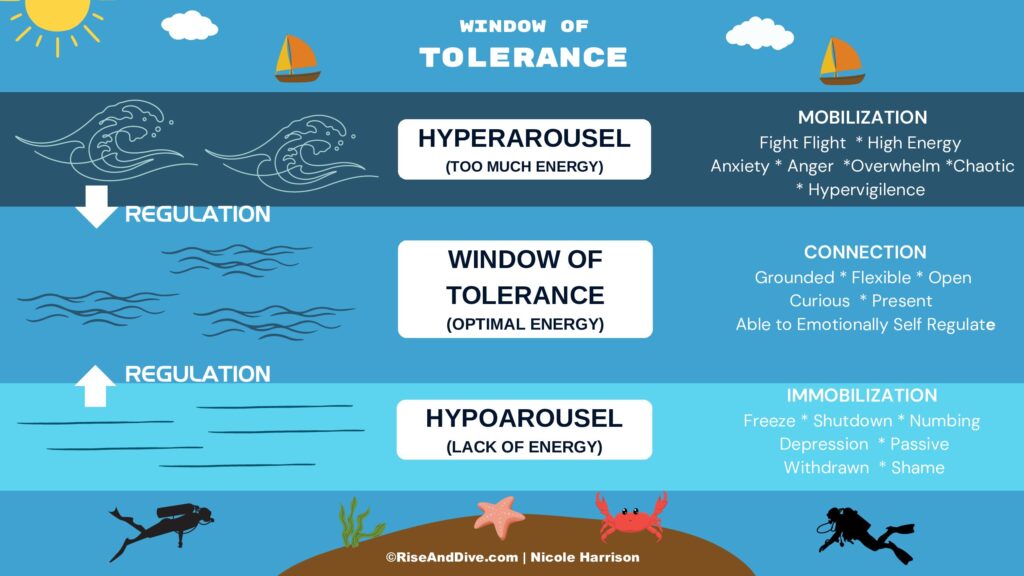
The window of tolerance is a concept from trauma-informed care. It describes the range of nervous system arousal inside which a person can function well: calm enough to think clearly, activated enough to respond, and present enough to make good decisions. Inside that window, you can regulate your breathing, read your environment, and trust your body. Outside it, the nervous system takes over, and rational thought becomes much harder to access.
I think of it like the ocean. The ocean shifts between calm and turbulent depending on tides, currents, and other conditions. Your nervous system works the same way, constantly adjusting to what is happening around and inside you. When something pushes you outside your window, whether that is a strong current, low visibility, a flooded mask, or simply the anticipation before a descent, you stop responding and start reacting. That distinction matters underwater.
Understanding your window does not mean eliminating fear. It means learning to recognize where you are in relation to it, and knowing what brings you back.
When the Nervous System Goes to Stormy Seas
Hyperarousal is what most people recognize as anxiety. The nervous system has entered fight-or-flight mode, and the body follows. Before a dive, this can look like anticipatory dread, racing thoughts, and an impulse to cancel. Underwater, it can look like rapid shallow breathing, difficulty focusing, and a pull toward the surface that feels urgent even when conditions are fine.
Common signs of hyperarousal underwater:
- Breathing becomes rapid and shallow
- Thoughts accelerate and are hard to slow down
- Difficulty maintaining focus on the environment or your buddy
- A strong, non-specific urge to surface
- Air consumption spikes without a clear reason
The nervous system is not broken here. It is responding. Knowing that is the first shift.
When the Nervous System Goes Flat
Hypoarousal is less discussed but just as real. This is the nervous system moving into shutdown rather than alarm. It can happen before a dive as a kind of numbing, the feeling that you cannot get yourself to care, to gear up, to find the motivation you know should be there. Underwater, it shows up as detachment, slow responses, and a sense of going through the motions without being present for any of it.
Common signs of hypoarousal:
- Avoiding dives without being able to name why
- Feeling numb or emotionally flat before or during a dive
- Sluggish movements and slow responses to your environment
- A sense of disconnection from the experience as it is happening
- Significant fatigue after dives, beyond what the physical effort explains
Both ends of the spectrum pull you outside your window. Both are workable. If you want a broader map of what dive anxiety can look like and what helps, 8 Ways to Overcome Dive Anxiety covers the full picture.
How to Return to Your Window Underwater
These are the tools I use myself and bring into my work with women divers. None of them is complicated. What makes them effective is practicing them before you need them, so that when the nervous system activates, they are already in your body rather than just in your head.
Breath control
The most direct route back into your window. Your breath is the one physiological process you have voluntary control over, and slowing it down sends a clear signal to the nervous system that you are safe. A slow exhale is especially effective. Practice this on land before you ever need it in the water.
Grounding
Touch something solid. The texture of the sand at the bottom, a steady hold on the anchor line, your feet planted on the boat deck before you roll in. Grounding returns attention to the body and the immediate environment rather than to the story the nervous system is running.
Co-regulation with your dive buddy
Nervous systems are social. A calm presence genuinely helps regulate an activated one. This is part of why who you dive with matters as much as conditions and equipment. Let your buddy know what you need before you enter the water. A steady look, a thumbs up, a hand on the shoulder. These are not small things. Expand your window of tolerance and improve your sense of confidence, safety, and overall enjoyment.
Movement and post-dive recovery
After a hard dive or a moment of activation, movement helps the nervous system complete what it started. A walk, a stretch, time in the shallows without a task. The body needs to process what happened. Giving it space to do that makes the next dive easier.
These tools are the foundation of the work I do inside the Dive Somatics™ framework. If you want to understand how somatic practice connects directly to the diving experience, Somatics and Scuba Diving goes deeper into that connection.
What the Window of Tolerance Teaches You Off the Dive Boat
This is the part that surprised me most.
I started this work because I wanted to be a better diver. What I did not anticipate was how much the practice transferred. Learning to recognize when I had left my window, learning what brought me back, learning to stay regulated when conditions felt uncertain: none of that stayed on the boat when I climbed out.
It showed up in how I handled a hard conversation. In how I moved through a decision that felt too big for the moment. In how I held still when everything in me wanted to react. Water is one of the cleanest environments for practicing that distinction. Fear as information rather than instruction. And what you practice at depth carries.
When you expand your window of tolerance underwater, you expand it. That is not a metaphor. It is physiology. The nervous system does not know it is sixty feet down. It knows it is learning something new about safety, and that learning goes with you.
How to Expand Your Window Over Time
The window is not fixed. Every time you return to regulation from a place of activation, you teach your nervous system that it can. That range widens with practise. Situations that once pulled you out, strong current, unexpected surge, an equipment issue mid-dive, become more manageable, not because they are less real, but because your nervous system has more history navigating them.
This is not the same as pushing through. Pushing through without regulation can reinforce the alarm response over time. Returning to regulation with intention is what actually expands the window. One builds capacity. The other depletes it.
The window of tolerance is not a fixed limit. It is a range you can learn to recognize, return to, and expand. And what you build in the water does not stay there. The nervous system carries what it learns into the next dive and into the life you are living on land.
Ready to Go Deeper?
If this resonated, there is a community of women divers working through exactly this. Women In Scuba Empowered (WISE) is where the conversation about dive anxiety, nervous system regulation, and what it actually feels like to build real confidence in the water lives. Come find us.
If you are on the email list, watch for more on the Dive Somatics™ framework, the methodology I developed to bring somatic practice directly into dive training. It builds on everything in this post and goes further.
Not on the list yet? Sign up here, and I will send you updates as this work develops.
With calm and confidence,

What is the window of tolerance, and why does it matter for scuba divers?
The window of tolerance describes the range of nervous system arousal within which you can think clearly and respond intentionally. For divers, staying inside that window means better air consumption, clearer decision-making, and more presence in the water. When you leave it, minor problems can feel unmanageable fast.
Can dive anxiety be fixed, or is it something I just manage forever?
Dive anxiety is not a permanent condition. The nervous system is adaptable. With the right tools and consistent practise, the window of tolerance expands, and situations that once triggered significant anxiety become much more workable. Women who work with this framework describe the shift not as eliminating anxiety but as gaining access to a version of diving that actually feels like theirs.
What causes hyperarousal versus hypoarousal in diving?
Hyperarousal is typically triggered by perceived threat: unfamiliar conditions, unexpected equipment issues, or a descent that feels faster than expected. Hypoarousal often follows repeated difficult experiences or prolonged low-grade dread. Both are nervous system responses, and both respond to the same foundational tools: breath, grounding, co-regulation, and recovery
Does this apply to experienced divers, not just beginners?
It is not experience-level specific. I have more than 1,000 dives and still work with my window of tolerance before and during dives. The framework is as useful for an experienced diver revisiting a challenging site as it is for someone on her first open-water dives. Skill level changes. The nervous system stays
