
Women’s Scuba Diving in Bonaire: The Complete Guide for Women Who Want More Than a Dive Trip
A guide to diving in Bonaire, including the best dive sites, travel planning, and what divers can expect underwater.
Why Bonaire is a Bucketlist Dive Destination for Women
Women’s scuba diving in Bonaire offers something most dive travel does not: room to be fully present in the water and to bring something back from it.
Most women who find their way to this page have already tried something that did not quite fit. Maybe it was a co-ed dive trip where the pace was set by someone else, and you spent the week managing yourself around it. Maybe it was a dive shop that handed you a certification card and left you to figure out the rest. Maybe you have been diving for years and are still waiting for a group that meets you where you are.
Bonaire is not a fix for any of that. But it is a destination with conditions so specific, and a structure so well-matched to what an intentional woman diver needs, that it creates something most dive travel does not: room to be fully present in the water and to bring something real back from it.
This guide covers the conditions, the sites, the guide question, dive anxiety, diving over 50, how to structure your days in the water, and what Rise & Dive℠ brings to this particular destination. Nicole Harrison is a PADI Instructor, trauma-informed coach, and the creator of Dive Somatics℠, a body-based methodology built at the intersection of nervous system regulation and the underwater environment. She selected Bonaire for Rise & Dive℠ women’s trips because of the specific conditions there and what it offers the women she leads.
Is Bonaire Good for Women Divers?
Yes. And the reason matters more than the answer.
Bonaire sits outside the hurricane belt off the northern coast of Venezuela. Its west coast is sheltered by the island itself, which keeps the current minimal and conditions predictable year-round. Visibility runs 60 to 100 feet. Water temperature holds between 78 and 82 degrees Fahrenheit in any month. The reef has been a protected marine park since 1979 under STINAPA Bonaire, one of the oldest marine park protections in the Caribbean, and the coral density and fish populations reflect decades of that care. There are more than 80 named dive sites, most of which are reachable within minutes of shore.
What that combination produces for a woman who has been carrying a full schedule and a long to-do list up until the moment she steps on the boat is something worth naming directly. The friction that burns energy before you hit the water on most dive trips largely disappears here. No mandatory current to manage the second you descend. No disorienting low visibility. No gear setup that requires a logistics brain to execute. The conditions allow you to focus your attention on what’s right in front of you.
What you do with that attention is the interesting part.
Is Bonaire good for women divers? Bonaire is one of the most consistent Caribbean dive destinations for women at any level. Calm west coast, high visibility, minimal current, and protected reef make it forgiving without sacrificing quality. For women diving with intention and the right support, it is exceptional.
Why Bonaire Works for Women Divers
Most dive destinations ask you to adapt to them. Bonaire has a natural structure that works unusually well for the way women tend to dive when they are diving on their own terms.
The west coast is calm by geography, not luck. The reef runs close to shore the length of the island. Tanks are available and accessible. The logistical weight of getting in the water, which drains a significant amount of energy at most destinations, is lighter here than almost anywhere else in the Caribbean.
Which means that for women who arrive carrying everything they always carry, something shifts the moment the logistics are no longer theirs to manage.
Into the dive itself. Into what happens at depth when the nervous system is not on high alert managing the unfamiliar. Into noticing what is there: the fish, the coral, the quality of the light, the way the body moves differently underwater when it is not braced against something.
What a woman experiences in that kind of water does not stay underwater. That is the principle behind all Rise & Dive work. The stillness, the presence, the reset that happens at depth: it carries. Into how she moves through pressure on land. Into how she trusts herself when the next step is not clear. That is not aspirational language. It is physiology. The body learns in water. What it learns translates.
Bonaire’s conditions create unusually good circumstances for that to happen.
For a deeper look at what specifically makes this destination distinct from every other Caribbean option: Why Bonaire Diving Feels Different from Anywhere Else You Have Dived.
What the Diving Is Actually Like in Bonaire
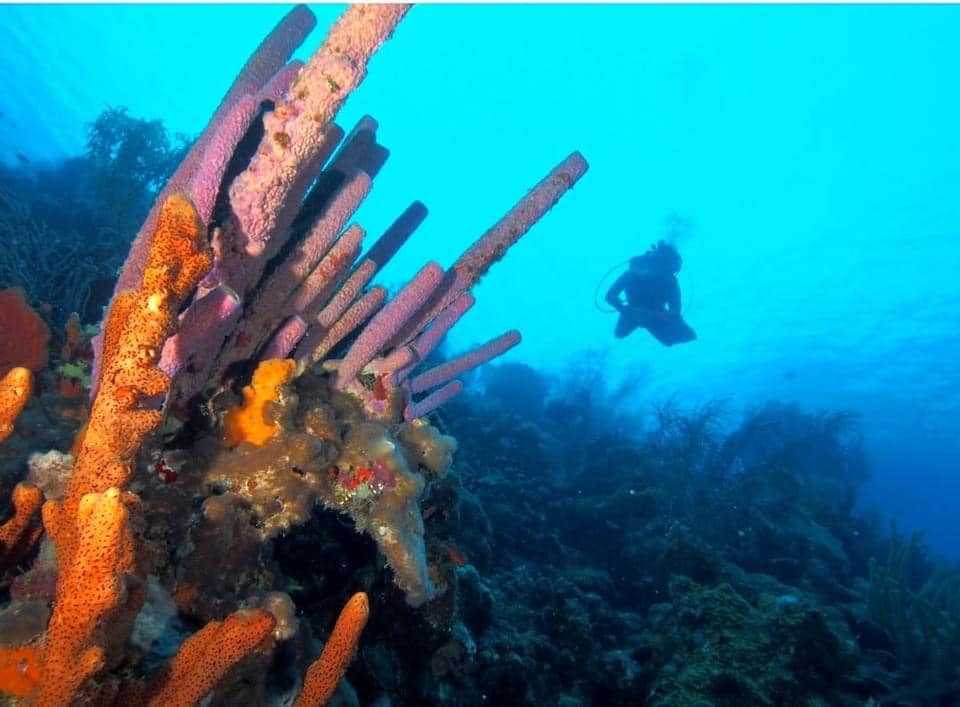
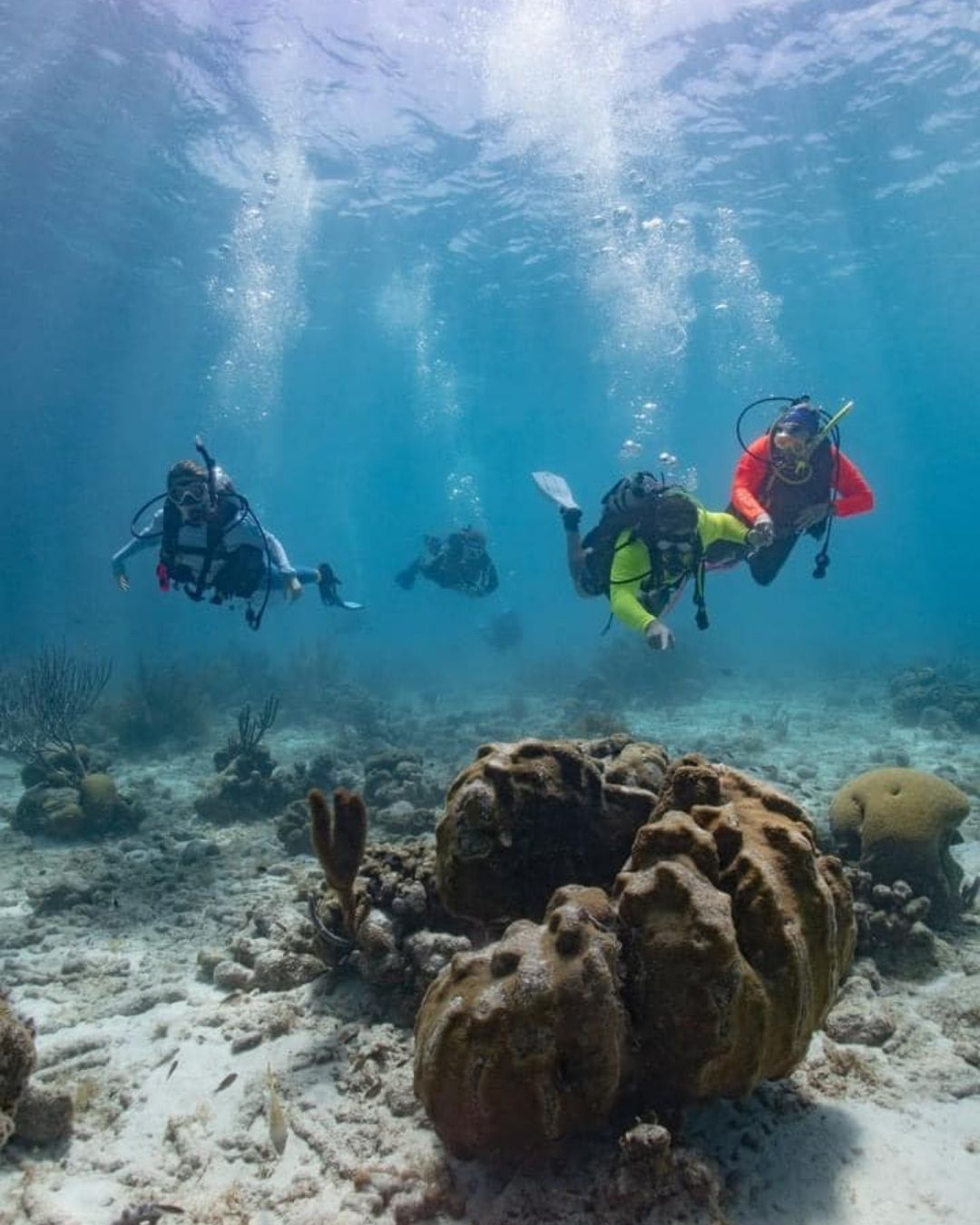
The west coast of Bonaire is a permanent marine park. No fishing, no anchoring, no spearfishing. The reef reflects decades of protection, and it shows. Coral coverage that would be exceptional anywhere is routine here.
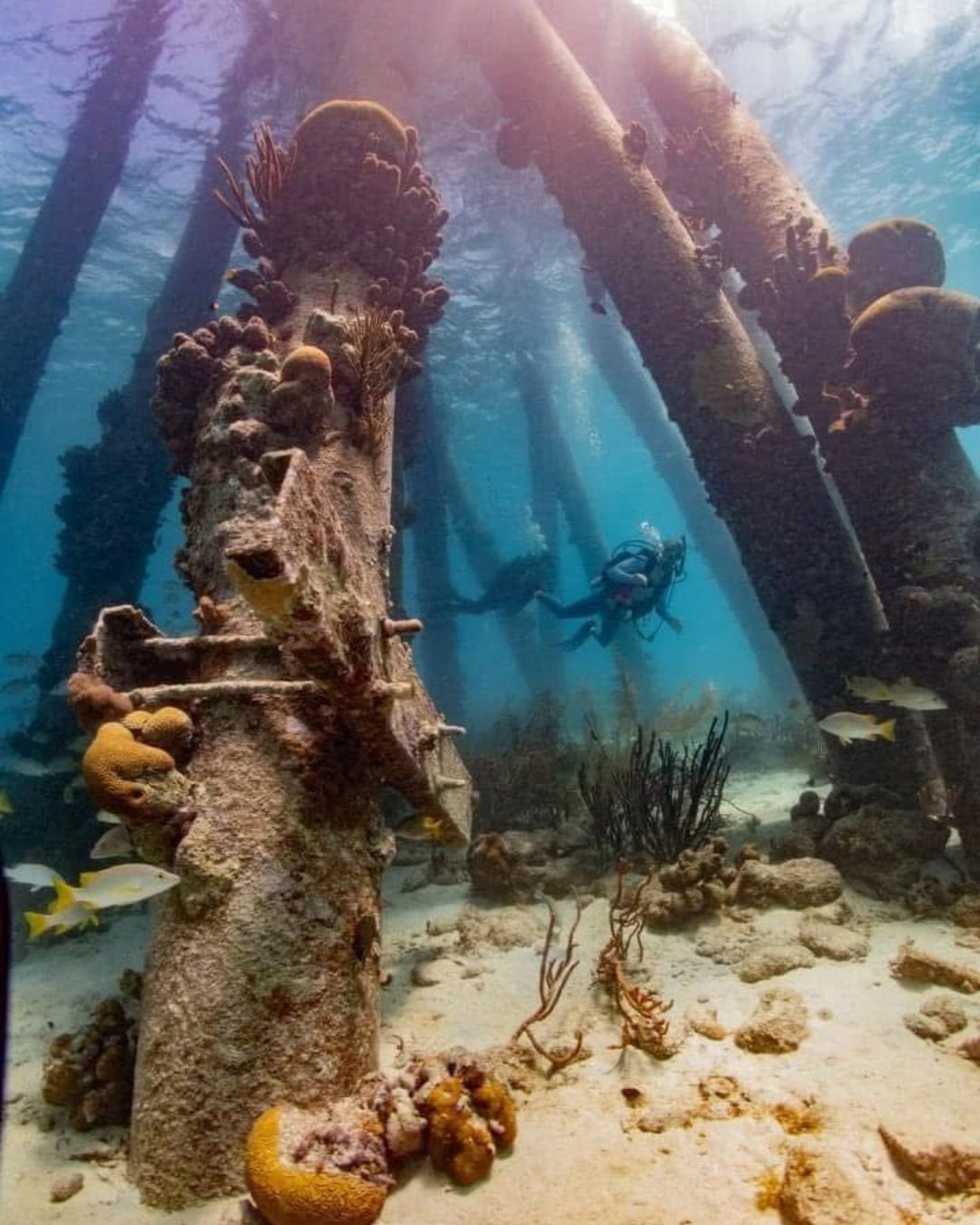
Salt Pier is one of the most recognized sites in the Caribbean. The pilings are encrusted in coral and surrounded by fish populations that have concentrated around the structure for years. Bari Reef sits in front of the main dive operators and works as both an orientation dive and a site that rewards repeated visits at different times of day.
Klein Bonaire, the small uninhabited island just offshore, is accessible only by boat and holds some of the most pristine reefs in the region: unhurried, dense, and consistently good. The Hilma Hooker is the island’s wreck dive, a 236-foot freighter resting at 90 to 100 feet with excellent visibility and a fish population that has made the structure home.
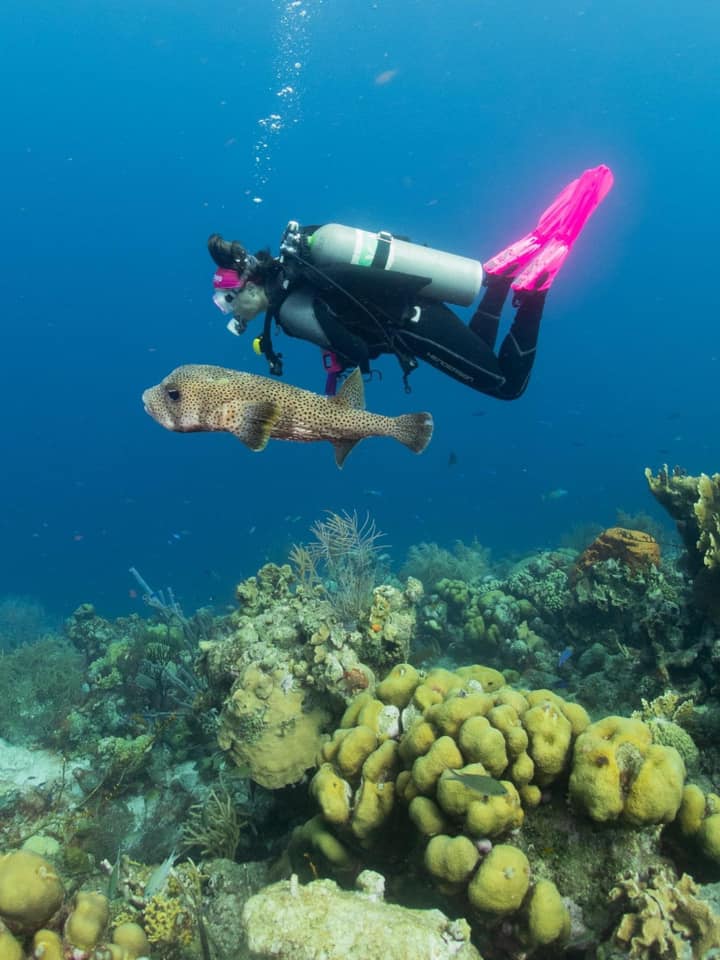
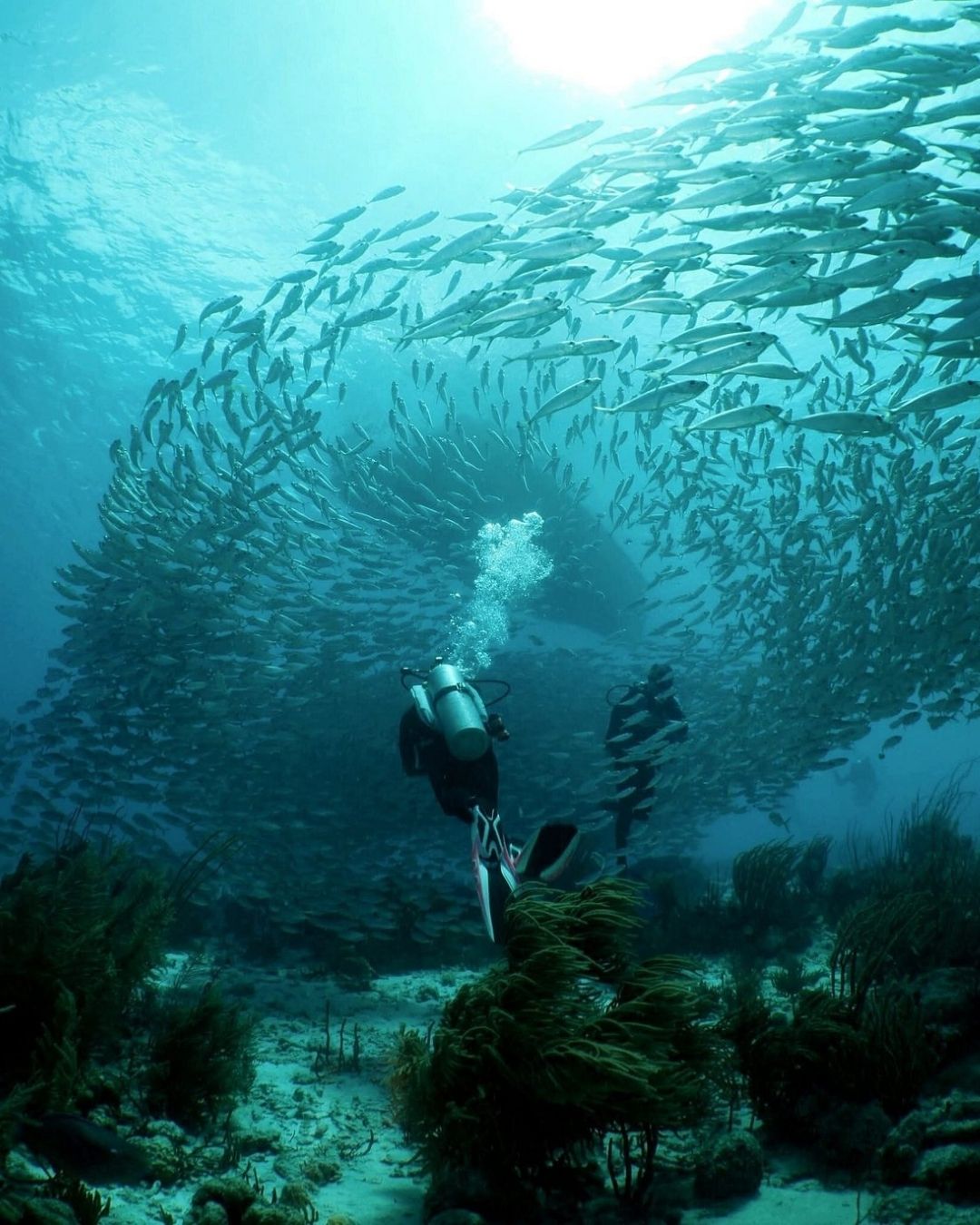
The marine life Bonaire is known for is not incidental. Green sea turtles are a constant presence on most west coast sites. Spotted eagle rays move through the water column with a pace that invites you to slow down and follow. Reef sharks patrol the deeper structures. Seahorses hold to coral fans in the shallower sections if you are moving slowly enough to find them. Schooling fish, including blue tangs, parrotfish, and French grunts, move in numbers that reflect what a healthy protected reef actually looks like. Nicole has dived these sites with the women she leads, and the consistency of the marine life is one of the reasons Bonaire is on the Rise & Dive calendar.
Water temperature year-round means a 3 mm wetsuit handles the job for most divers. Visibility on a typical day runs 60 to 80 feet. On a clear day, it exceeds 100. October, when the Rise & Dive℠ trip runs, sees peak water temperature, around 82 degrees Fahrenheit, with strong visibility and noticeably lower boat traffic than in the summer months. The conditions in October are among the best the island offers, and the water feels less crowded. For the full seasonal breakdown: The Best Time to Dive Bonaire (And Why October Is Underrated).
What this produces in practice is diving that rewards presence and patience. Slow movement. Long bottom times. The kind of dive where the point is not getting through it but being in it.
For the full conditions breakdown by month: Bonaire Diving Conditions: What the Numbers Actually Mean for Your Dive.
For a curated look at which specific sites deliver on a guided women’s trip: Bonaire Dive Sites: The Ones Worth Your Time on a Guided Women’s Trip.
Guided vs Independent: The Honest Distinction
Bonaire built its reputation on independent shore diving. Rent a truck, load your tanks, drive to a yellow rock marker, and you are in the water. That is genuinely available and a genuinely good option. It is also what most content about Bonaire assumes you want.
It is also worth being honest about what it actually requires.
Independent shore diving means managing the truck rental, the tank logistics, the site selection, the gearing up on the roadside, and every decision from the moment you wake up to the moment you surface. For some women, that is exactly what they want. For others, those considerations and logistics consume a significant amount of energy that would otherwise be spent on diving.
The question is not whether you are capable of doing it independently. Most women reading this are more than capable. The question is where you want your attention to go.
A guided trip removes the logistics burden. The boat handles transportation to sites that lack shore access. Someone who knows the reef has already made the decisions about where, when, and how long. The only thing left for you to focus on is the dive. That is not a small thing when the week you have taken to be here is likely the only week you have taken for yourself in a long time.
Choosing support over powering through the independent version is a decision about self-trust, not a question of capability. Women who dive with Rise & Dive understand the distinction.
For the full identity argument behind this choice: Bonaire Diving for Women Who Want Guided Support.
For the operational comparison between boat and shore access, site by site: Boat Diving vs Shore Diving in Bonaire: An Honest Guide.
For the direct answer to whether a guide is technically required: Do You Need a Dive Guide in Bonaire?.
Diving Anxiety and the Nervous System
Many divers experience anxiety at some point, and if that’s you, you probably know by now that dive anxiety does not go away by simply thinking harder. But most programs that address it work in the mind: tell yourself you are safe, count your breaths, manage your thoughts until the panic passes. For some women, those tools help at the surface. At depth, when the body has its own read on the situation, the mind’s reach is limited.
What actually changes the experience is learning to find safety in the body. Not as a mindset shift, but as a physiological one. That is a different skill, and it requires a different kind of support.
Bonaire’s conditions create an unusually good environment for that work. High visibility reduces the disorientation that drives a significant portion of underwater anxiety. The current is minimal on the West Coast, which means you’re not immediately in a situation requiring active management before you’ve had a chance to settle. The sites are forgiving. The water is warm. The physical inputs that trigger the nervous system into alert mode are fewer here than at almost any other dive destination.
Dive Somatics℠ is the methodology Nicole has developed at this specific intersection: nervous system regulation and the underwater environment. It draws on somatic practitioner training and trauma resiliency coaching, and it is grounded in what PADI and the broader dive medicine community have documented for decades, that anxiety, not equipment failure, is the primary reason divers surface early or never return. Dive Somatics℠ works in both directions. For the woman who is nervous before the dive, it gives her a way to find safety in her body before she needs it underwater. For the woman already diving, it teaches her to carry what the water gives back rather than leaving it behind on the boat.
For the full post on dive anxiety and what changes when the conditions and the support are right: Scuba Diving Anxiety and Bonaire: What Changes When You Have the Right Support.
Diving Over 50 in Bonaire
Some of you may have been thinking about this trip for a while. You’ve probably talked yourself out of it at least once, not because you don’t want to go, but because the version of this you’ve pictured involves keeping up with a group that was not built for you, asking questions you feel you should already know the answers to, and being the oldest one there in a way that is quietly noticeable.
That is not what this is.
The dive industry wrote most of its content for a 28-year-old. It did not write it for the woman who came to diving at 52, or who dove for years and took a gap, or who has 300 dives and simply wants a group that moves at the pace of someone paying attention rather than someone ticking sites off a list.
Bonaire suits her specifically. Its conditions reward the diver who moves deliberately. Slow, immersive reef dives with long bottom times and no current, requiring no management. Visibility that reduces spatial disorientation affects divers’ confidence when returning. Shore access that allows her to set her own pace without a boat schedule overriding it. Depth profiles that forgive. Marine life that rewards patience.
Regarding the fitness question, scuba diving is not an aerobic activity. The physical load happens above water, handling gear, moving on a boat, and getting in and out. A guided trip with proper structure handles the gear. What remains is the diving, and a healthy woman over 50 does that well.
The bigger question she is usually carrying is not whether her body can do it. It is whether she will feel like she belongs. That one is worth answering directly: she does.
For the full post written for exactly her: Scuba Diving Over 50 in Bonaire: What Nobody Tells You (And What Actually Matters).
How Many Dives Per Day
Many places in Bonaire sell unlimited tanks due to the independent shore diving. That is the offer, it is genuinely available, and it is one of the reasons women choose the island.
It is also not an instruction.
Nitrogen accumulates with every dive. Fatigue affects buoyancy control and judgment. Sensory saturation is real. There is a point where more dives produce less of what you actually came for. The women who leave Bonaire positively changed are almost never the ones who dove the most. They are the ones who dove with intention and stopped when the body said enough.
Most women have been trained to push past that signal. But the water teaches something different. Listening to what the body says about enough, actually stopping there instead of overriding it, is a skill. It turns out to be useful on land too.
A structure that works for most women: two to three dives daily for returning divers or those working with anxiety. Three to four dives for experienced divers with proper surface intervals. Four is a reasonable maximum, with the rest built into the itinerary deliberately rather than as an afterthought.
For the full breakdown with a dives-per-day recommendation table by experience level: How Many Dives a Day in Bonaire? What Your Body Is Actually Telling You.
The Rise & Dive Bonaire Women’s Trip
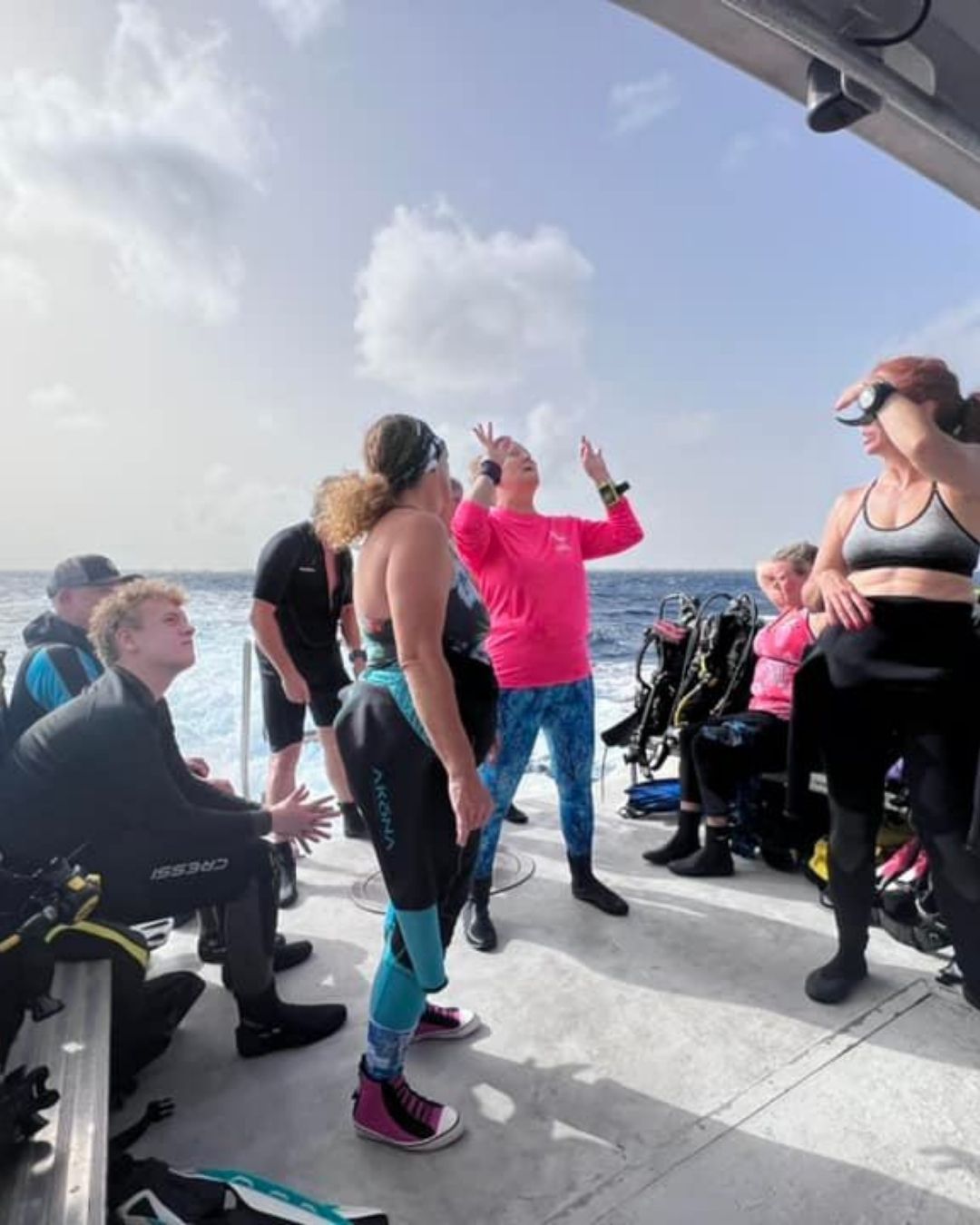
Here’s what you can expect from the Rise & Dive Bonaire women’s trip: Small group. Boat diving with vetted operators. Nicole is in the water with the group, not running logistics from the surface. Dive Somatics℠ is woven into the structure because it belongs there, not bolted on as an extra. The decisions that drain energy before the diving starts, where, when, with whom, and on what boat, have already been made.
Nicole chose Bonaire because of the specific conditions there and what they do for the women she leads. The calm water, the high visibility, the protected reef, the boat access to Klein Bonaire, and sites that shore diving cannot reach: all of it was evaluated against one question. What does this destination give a woman who wants to dive with intention and carry something home that lasts?
The October timing is deliberate. Crowd levels drop after the peak summer season. Conditions hold strong. The group has the water in a way that July and August cannot offer.
Spots are limited, and they go fast. If Bonaire has been on your list, this is the structure to use.
This trip grew out of the Women In Scuba Empowered (WISE) community, an active community of women divers inside the Rise & Dive ecosystem. The trip is open to all women who are ready to dive with intention. WISE membership is not a prerequisite.
For full trip details, pricing, inclusions, and how to secure a spot on the Rise & Dive Bonaire trip, click here.
To get updates on future Rise & Dive℠ trips and Dive Somatics℠ programming, get on the email list here.
Questions About Scuba Diving In Bonaire
Wherever you are in your dive journey, I’d be honored to help you rise with confidence and dive with clarity.
Frequently Asked Questions About Women Scuba Diving In Bonaire
Is there a women’s dive trip to Bonaire?
Rise & Dive runs a women-centered boat diving trip to Bonaire in October 2026, led by PADI Instructor and Dive Somatics℠ creator Nicole Harrison. It is a small-group guided trip built for women who want their diving structured around their experience from start to finish. Full details are here.
Is Bonaire good for women divers?
Yes. Bonaire’s stable conditions, minimal current, high visibility, and marine park-protected reef make it one of the most consistent Caribbean dive destinations at any experience level. For women diving with intention in a structured setting, it is among the best options in the region.
What if I haven’t dived in a few years — is this trip right for me?
Returning divers are a good fit for Bonaire and for Rise & Dive trips specifically. The conditions are forgiving, the pace is set around the group rather than the most advanced diver, and Nicole’s background as a PADI Instructor means there is genuine support for shaking off rust. The trip is not designed for brand-new divers, but a woman returning after a gap is exactly who it is built for.
What if I get anxious in the water?
Dive anxiety is workable, and Bonaire’s conditions are among the most favorable in the Caribbean for a nervous diver. High visibility, minimal current, and calm water reduce the sensory triggers that drive most underwater anxiety. Nicole developed Dive Somatics℠ specifically for this. The methodology is embedded in the trip structure rather than offered as a separate add-on. You do not need to have it figured out before you arrive.
Best Caribbean island for women to dive?
Bonaire is exceptional for its conditions, marine park protection, consistent visibility, and accessibility. Cozumel is Nicole’s home base and carries the deepest local knowledge she brings to any destination. Both deliver. The right choice depends on the woman, her experience level, and what she wants the trip to do for her.
Do you need experience to dive Bonaire?
Bonaire suits certified divers at most levels. The west coast is appropriate for Open Water certified divers. Some sites, including the Hilma Hooker wreck and deeper Klein Bonaire sites, require more experience. On a guided trip, site selection is handled based on the group’s certifications and comfort level. No one is dropped into conditions she is not ready for.
What is the diving actually like?
78 to 82 degrees Fahrenheit year-round. Visibility 60 to 100 feet on a typical day. Minimal current on the west coast. More than 80 named sites with protected reef status since 1979. Slow, immersive reef dives with healthy coral, green sea turtles, spotted eagle rays, reef sharks, and long bottom times. Boat access to Klein Bonaire and offshore sites that shore diving cannot reach.