
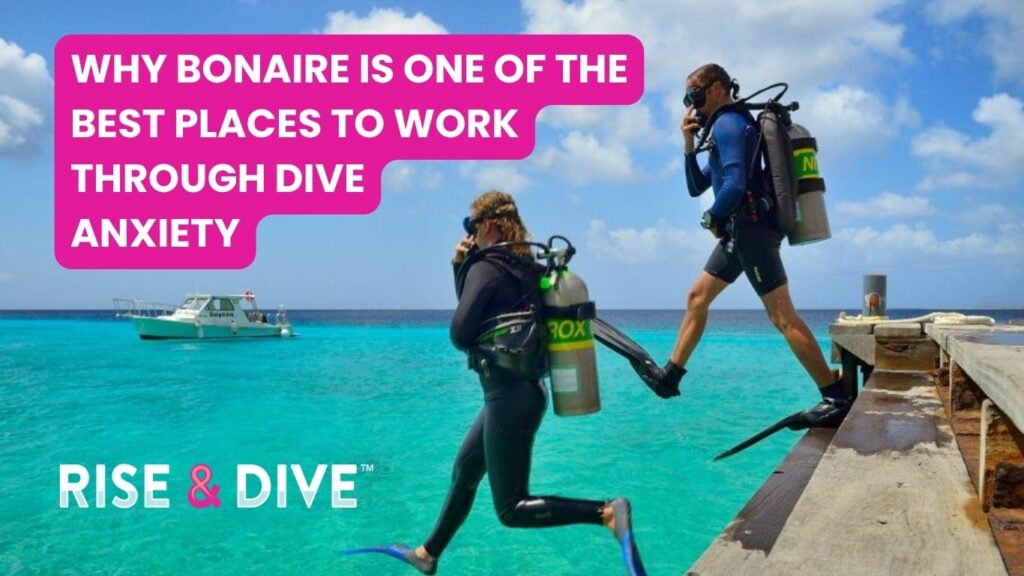
Bonaire has a reputation among divers for being calm, clear, and consistent. If you’re a diver who struggles with dive anxiety, Bonaire is definitely worth considering as your next dive destination, especially when you understand what its qualities actually mean for your experience in the water.
First off, this is not about Bonaire being an easy or boring dive destination. It is about Bonaire being the right kind of place to do real work on something that affects more divers than you might realize. As someone who has struggled with dive anxiety, personally, let me assure you that feeling anxious is not a character flaw. It is the nervous system doing exactly what it was built to do: scan an unfamiliar environment, flag the unknowns, and try to keep you safe. The problem is not that the warning signal fires. The problem is that most divers are never taught how to work with it.
Bonaire, particularly when approached with the right structure and support, is the perfect place to change all that.
Why Bonaire Makes a Difference for Dive Anxiety
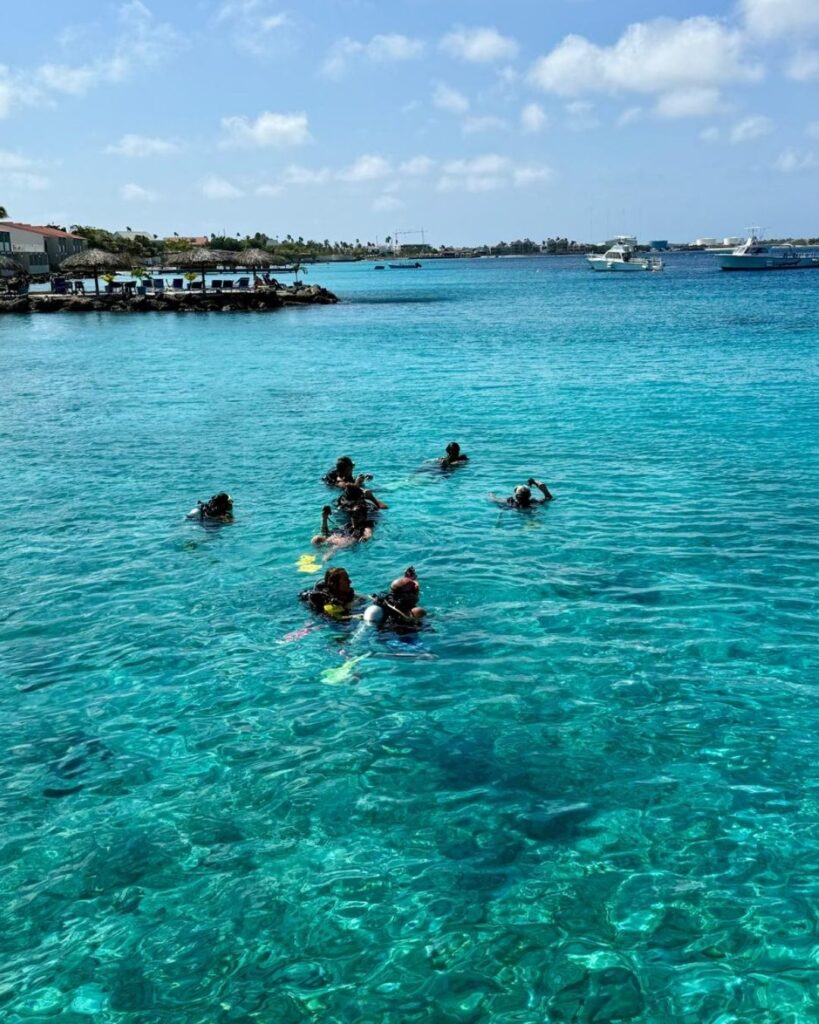
Bonaire’s easy shore entries and clear water reduce uncertainty before the dive even begins.
Many dive destinations add new variables and circumstances to navigate. Currents, low visibility, fast-paced group schedules, complex logistics. Each of those is a demand on a nervous system that is already working hard. But instead of piling on logistics, Bonaire has a way of lessening and removing them.
Water temperature ranges between 78 and 82°F year-round. Visibility runs 60 to 100 feet. The west coast of Bonaire, where most diving happens, carries minimal current. There is no mandatory group pace and no conditions that require you to perform before you are ready. For a diver whose anxiety spikes when the environment feels unpredictable or out of her control, these are not small details. They are the whole point.
Here is why that matters for a state of calm. When the nervous system reads a threat, real or perceived, it does not ask for an opinion. The response happens below the level of thought. Most advice on dive anxiety tells you to breathe slowly and think positive thoughts. That advice is not wrong. It is just incomplete, because no amount of thinking reaches where the anxiety actually lives. The best way to reach it is by allowing your body to learn that the environment is safe through repeated, calm experiences. Bonaire can provide you exactly that.
The visibility, in particular, does something specific. Disorientation is one of the biggest amplifiers of dive anxiety, and Bonaire removes it almost entirely. When you drop in, and you can see clearly in every direction, something settles. The reef is right there. The bottom is visible. You can see your buddy, your divemaster, and the direction you came from. That clarity is not just pleasant. It is regulating. Your system then gets to spend its energy being present and focused on the dives a day rather than on managing the unknown.
What Bonaire also gives you is time. A week of multiple dives per day. Repetition. The body genuinely settles through repeated safe exposures. It doesn’t happen through a single breakthrough moment, but through a reliable rhythm that makes real progress possible.
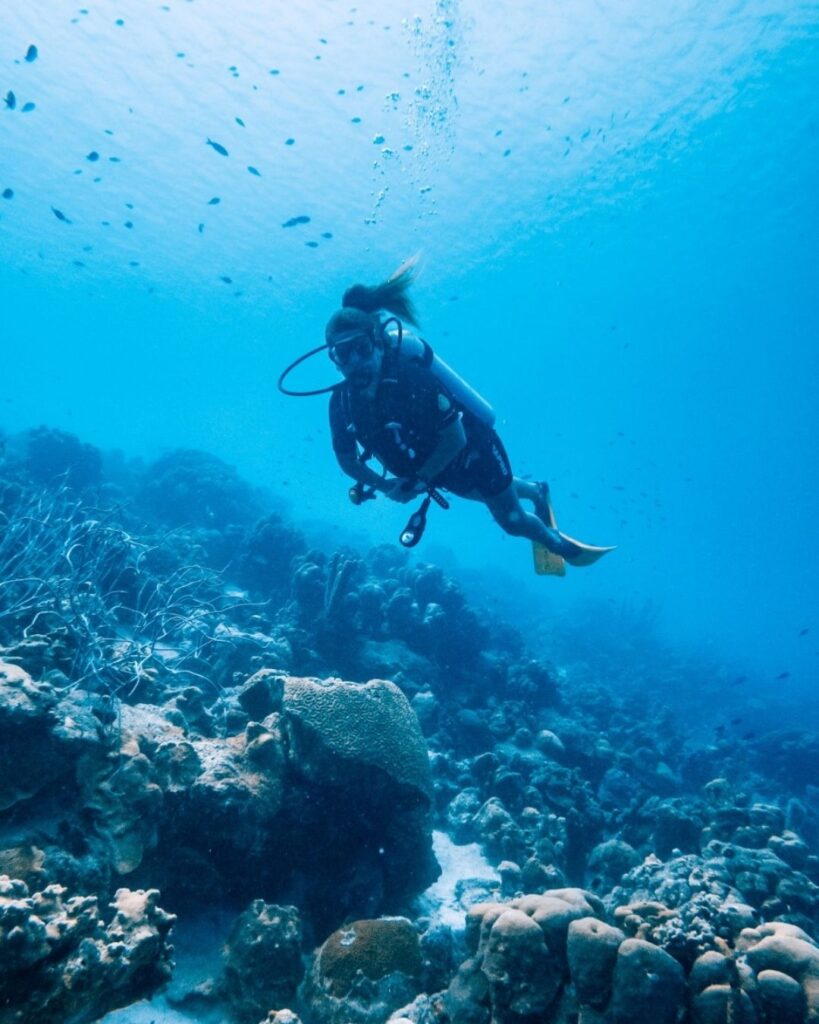
Strong visibility in Bonaire helps reduce disorientation and supports a calmer dive experience.
Why Guided Structure Matters
Bonaire is famously a great destination for independent shore diving. That works well for many divers, but for a diver working through anxiety, it can add a layer of pressure that a dive guide may hope to avoid.
Managing your own logistics, renting a truck, loading tanks, driving to yellow rock markers, gearing up roadside, making every decision before you have even put your face in the water, takes energy. Energy spent on logistics is energy not available for the actual work of being present in the water. It is one of the reasons a small-group boat diving structure changes the experience entirely.
On a Rise & Dive Bonaire dive trip, the details are handled. You arrive, you dive, and your attention gets to stay in the water where it belongs. That structure is not a concession to anxiety. It is a design decision about what the experience becomes, and one that removes the obstacles that normally feed into it. A guided, women-centered trip is designed to reduce or even remove that mental load.
When you are diving alongside women who understand what you are carrying, accompanied by experienced dive leaders who have seen this specific kind of fear in the water many times, something shifts. Not immediately. But over the course of a week, the grip loosens.
Not because the fear was wrong. Because it got a different answer than it was used to getting.
The woman who steps off the platform on day six is not the same woman who locked up on day one. Not because she forced her way through something. Because she learned what her body actually needs, and she gave it that. And that learning does not stay in Bonaire. It comes home with her.
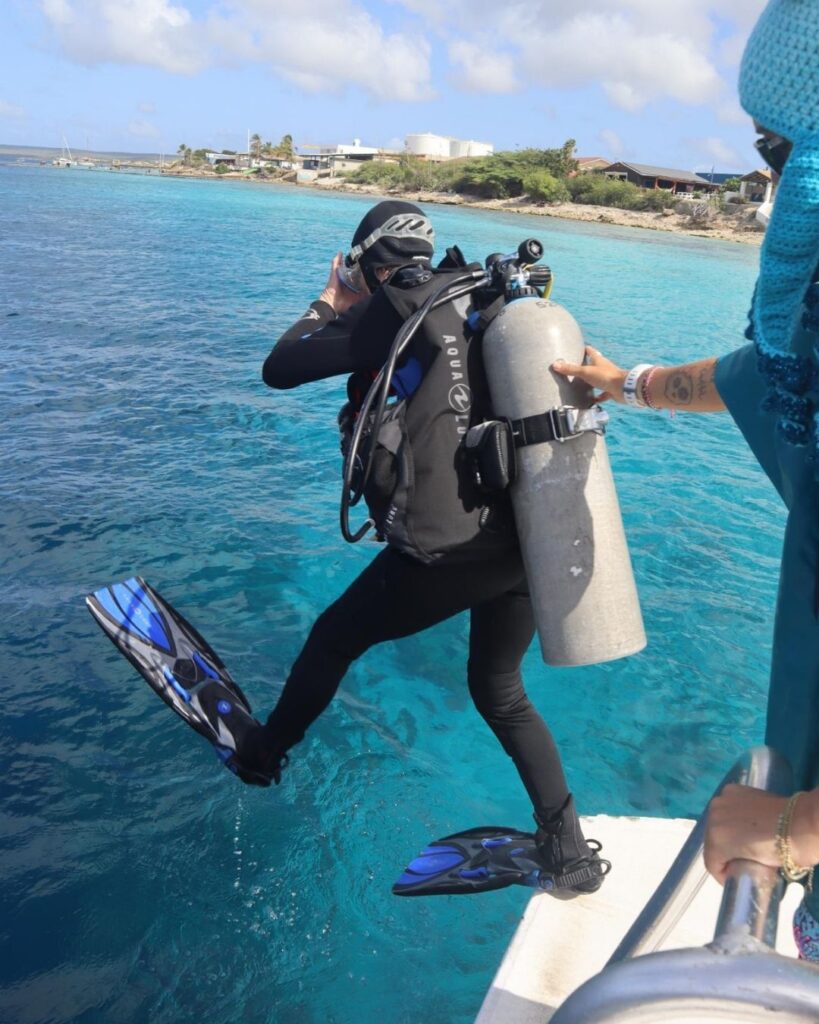
With the right structure and support, even simple moments like a giant stride become steady and controlled.
What This Means for You
If dive anxiety has been keeping you from diving the way you want to dive, Bonaire may be the destination that helps you change that pattern. Not because it is the easiest or least challenging destination, but because it is one of the most forgiving, and because the right structure makes the necessary work all the more possible.
The conditions here do something specific that most destinations cannot. Calm water, consistent visibility, minimal current, and a pace that is never forced give the nervous system room to settle. That is not a side benefit. It is the whole design.
Our Rise & Dive Bonaire trip is built around exactly that. Small group, intentional structure, and everything handled so your energy stays where it belongs: in the water.
Until the next dive,
Three Questions Divers Ask About Anxiety and Bonaire
Is Bonaire actually good for divers with anxiety?
Yes, specifically because of what it removes rather than what it adds. Calm water, exceptional visibility, minimal current, no mandatory pace, and consistent conditions all year mean the environment is not generating new challenges while you are working through existing ones. That combination is rare, and it matters.
Why do I still feel anxious even when I know I am safe?
Because your nervous system is not responding to what you know. It responds to what it remembers and anticipates. Scuba diving anxiety before a dive is often a cumulative signal built from past experiences where you felt unsupported, rushed, or out of your depth. Knowing you are technically safe does not automatically update that signal. Body-based practice does.
How does Dive Somatics℠ actually help with dive anxiety?
Dive Somatics℠ works by teaching you to recognize and work with what your body is doing rather than trying to override it. A grounded body before the dive is not a performance. It is preparation. And the skills you build in the water, the ability to come back to center under pressure, carry directly into how you move through stress and uncertainty on land. The water teaches it first. Life gets the benefit.
