
Small-group scuba diving offers a fundamentally different experience from diving in a large group, and most divers feel it from the moment of their first descent. It’s not about exclusivity. It’s about what becomes possible when the environment is designed around awareness and personal growth rather than logistics.
The size of the group you dive with quietly shapes everything about the dive experience: how quickly you settle in, how present you feel once you are at depth, how your body responds to the water. For many scuba divers, this difference shows up in dozens of small details that together shift the entire tone of a trip.
How Small-Group Scuba Diving Creates a Different Kind of Trip
In small-group scuba diving, the pace naturally slows. There is less pressure to rush through briefings, gear up quickly, or descend as a tight cluster. Divers have more time to prepare mentally and physically before entering the water, and that transition matters more than most people realize.
When there is space to move at a measured pace, breathing steadies sooner. Buoyancy comes online more easily. Attention shifts away from external noise and focuses toward the dive itself. The nervous system has time to settle and calm before the dive demands anything of it, and that immediately changes how the water feels.
Attention That Supports Awareness, Not Performance
Large groups ask a lot from divers before a single breath is taken underwater. Staying oriented within a crowd, reading multiple signals, and positioning within a moving cluster requires constant background processing. In small-group scuba diving, that load softens considerably.
With fewer people to track, divers can focus on their own movement, their breath, and the environment around them. Questions can be asked without feeling disruptive. Adjustments can be made without drawing attention or causing self-consciousness. The dive becomes less about keeping up and more about staying present, which is where the real experience lives.
A Rhythm That Follows the Reef, Not the Clock
Small-group scuba diving allows dives to unfold in conversation with the reef rather than in response to group logistics. Depth changes can be gradual, and movement can follow natural contours instead of predefined paths. When something worth pausing for appears, the group can actually pause, without throwing off the schedule or losing half the party.
This rhythm creates dives that feel immersive rather than segmented. Encounters with marine life feel less rushed, and the environment becomes something you move through with intention, not something you scramble to keep up with.
Learning and Buoyancy That Integrate Naturally
Skill development works differently in small groups, and the difference is not just about instructor attention. It is about how the body receives information when it is not under pressure. As a PADI Instructor, I see this play out in every water entry: divers who are not managing crowd noise settle into their buoyancy faster and hold it more consistently.
That observation is grounded in somatics and nervous system research. When the body is not in threat-response mode, it is not defending. It is not scanning for the next thing to manage. And a body that is not defending is one that can actually receive new information. Feedback lands and stays. Corrections feel like guidance rather than criticism. Improvements become embodied rather than intellectual, and that is when they carry forward into the next dive rather than disappearing the moment the group gets back on the boat.
The Quality of Connection
Small groups develop a shared rhythm quickly, both underwater and on the surface. Divers become familiar with each other’s pace, communication style, and energy. That familiarity builds trust, and trust reduces the low-level stress that can sit just underneath the surface of a dive experience, even for confident divers.
Over the course of a trip, that rhythm accumulates into something that extends beyond individual dives. Divers surface from small-group trips feeling more grounded and more themselves, not just because the dives were good, but because the environment supported them consistently throughout.
Why This Matters for Dive Travel
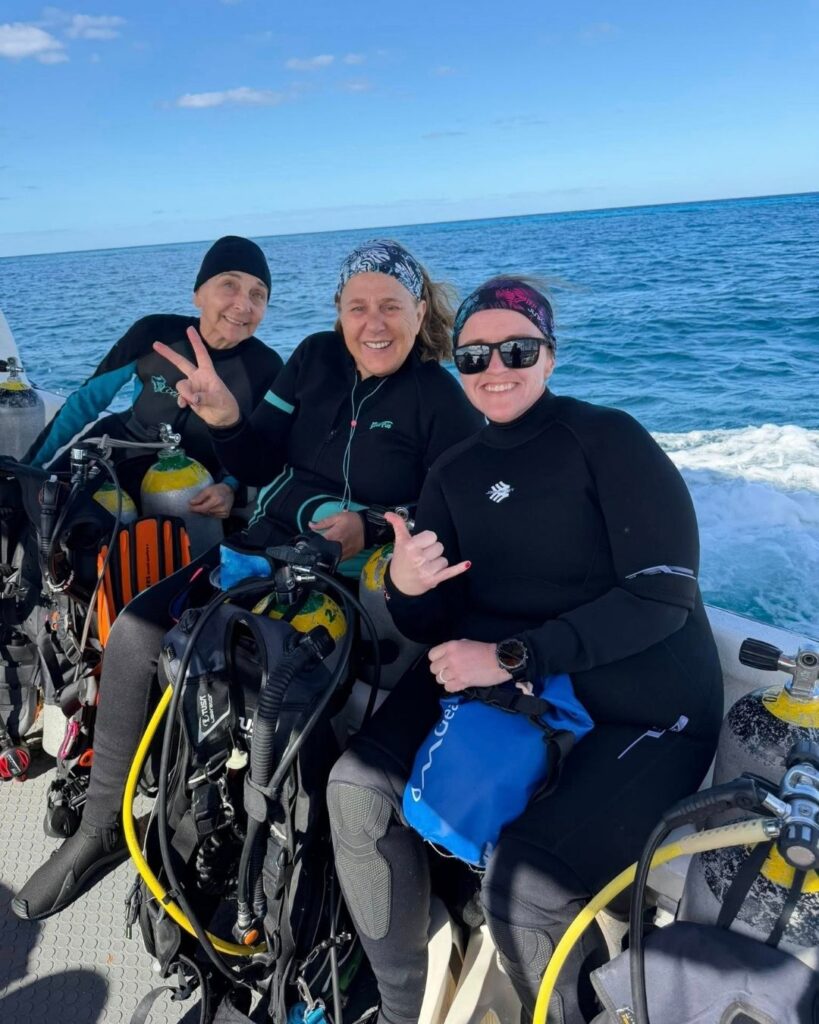
When scuba diving is part of a structured trip, the group size shapes the entire arc of the week. Large groups ask divers to constantly adapt, which breeds fatigue rather than confidence. Small groups create conditions in which rest and integration happen naturally between dives, and each day builds on the one before.
For women scuba diving in a small group setting, this design choice carries extra weight. The ability to ask questions, move at your own pace, and receive feedback without an audience changes what the trip can actually deliver.
Small-group scuba diving is not a logistical preference. It is a design decision that prioritizes presence over performance, awareness over keeping up, and genuine experience over appearance.
Learn “Why Bonaire Is One of the Best Places to Work Through Dive Anxiety” here.
What to Look For in a Small-Group Scuba Diving Trip
Not all small-group dive trips are structured the same way. Group size alone does not guarantee the experience described above. When evaluating a small-group scuba diving trip, a few things are worth asking directly.
How many divers are in the water together at one time? Is the leader in the water with the group, or directing from the surface? Is the pacing structured around the divers or around the dive sites? And perhaps most importantly: who is actually leading the trip, and in what capacity?
There is a real difference between a trip led by the owner of a dive travel company who built the experience herself, a hired guide assigned to the group by a dive shop, and an instructor who was brought in to fill a role. The owner-operator has the most at stake in the quality of every dive. The experience was designed by the person leading it, not handed to someone to execute.
Learn why “Guided Diving in Bonaire for Women: Even Better Than You Think” here.
The answers to those questions indicate whether the small group is a design principle or merely a marketing description. On a Rise & Dive trip, small-group diving is a structural choice. I own and operate Rise & Dive, I am a PADI Instructor, and I dive alongside participants on every trip. I support the experience in the water and on land, and pace the week to help each diver settle in, integrate, and feel genuinely supported from the first dive to the last. To view upcoming trips and see if they would be a good fit for you, click here.
With calm and confidence,